Eluned Smith

Research Areas
Professor Smith’s research uses rare beauty-hadron decays, measured with the LHCb detector at CERN, to search for physics beyond the Standard Model. Although new particles may be too heavy to produce directly at the LHC, they can alter the rates and angular distributions of known decays. These observed tensions are collectively referred to as the flavor anomalies. Her group develops high-dimensional and amplitude-analysis techniques to determine whether they arise from new short-distance physics or from poorly understood strong-interaction effects. The group is now applying these methods to data from the upgraded LHCb detector.
Her research also includes detector development for LHCb Upgrade II. Her group develops ultra-low-latency machine-learning algorithms for radiation-hard FPGAs, including real-time waveform compression and pulse-shape reconstruction in front-end calorimeter electronics.
Beyond the LHC, she helps lead the flavour-physics programme for the proposed FCC-ee electron-positron collider, studying how its clean environment and very large samples of beauty hadrons could enable precision measurements of rare decays that are difficult or impossible at existing experiments.
Biographical Sketch
Prof. Smith completed her undergraduate and PhD at Imperial College London, graduating in 2017. She did her first post-doc at RWTH Aachen before winning an Ambizione Fellowship from the Swiss National Science Foundation at the University of Zürich. She joined MIT in 2023.
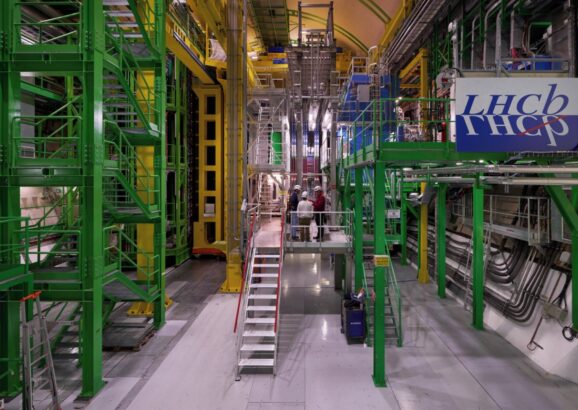
3 Questions: Searching for new physics with “beauty” particles
Prof. Eluned Smith says new LHC data still clash with the Standard Model, but we need more evidence to know if it's truly "new physics."
Awards & Honors
- 2026 // Outstanding Mentor Award from the MIT Undergraduate Research Opportunities Program
- 2022 // Emmy Noether Early Career Grant, Deutsche Forschungsgemeinschaft
- 2021 // Ambizione Fellowship, Swiss National Science Foundation
Key Publications
-
A comprehensive analysis of the B0 → K∗0µ+µ− decay PRL 137 (2026) 021802 https://inspirehep.net/literature/3094698
-
Test of Lepton Flavor Universality with B0 s → ϕℓℓ Decays PRL 134, (2025) 121803
-
Comprehensive analysis of local and nonlocal amplitudes in the B0 → K∗0µ+µ− decay JHEP 09 (2024) 026
-
Govorkova et al. Enabling Low-Latency ML on Radiation-Hard FPGAs with hls4ml https://arxiv.org/abs/2602.15751
-
Branching fraction measurements of the rare B0 s → ϕµ+µ− and B0 s → f′ 2(1525)µ+µ− decays PRL 127 (2021) 151801