Kehang Bai, Pappalardo Fellow
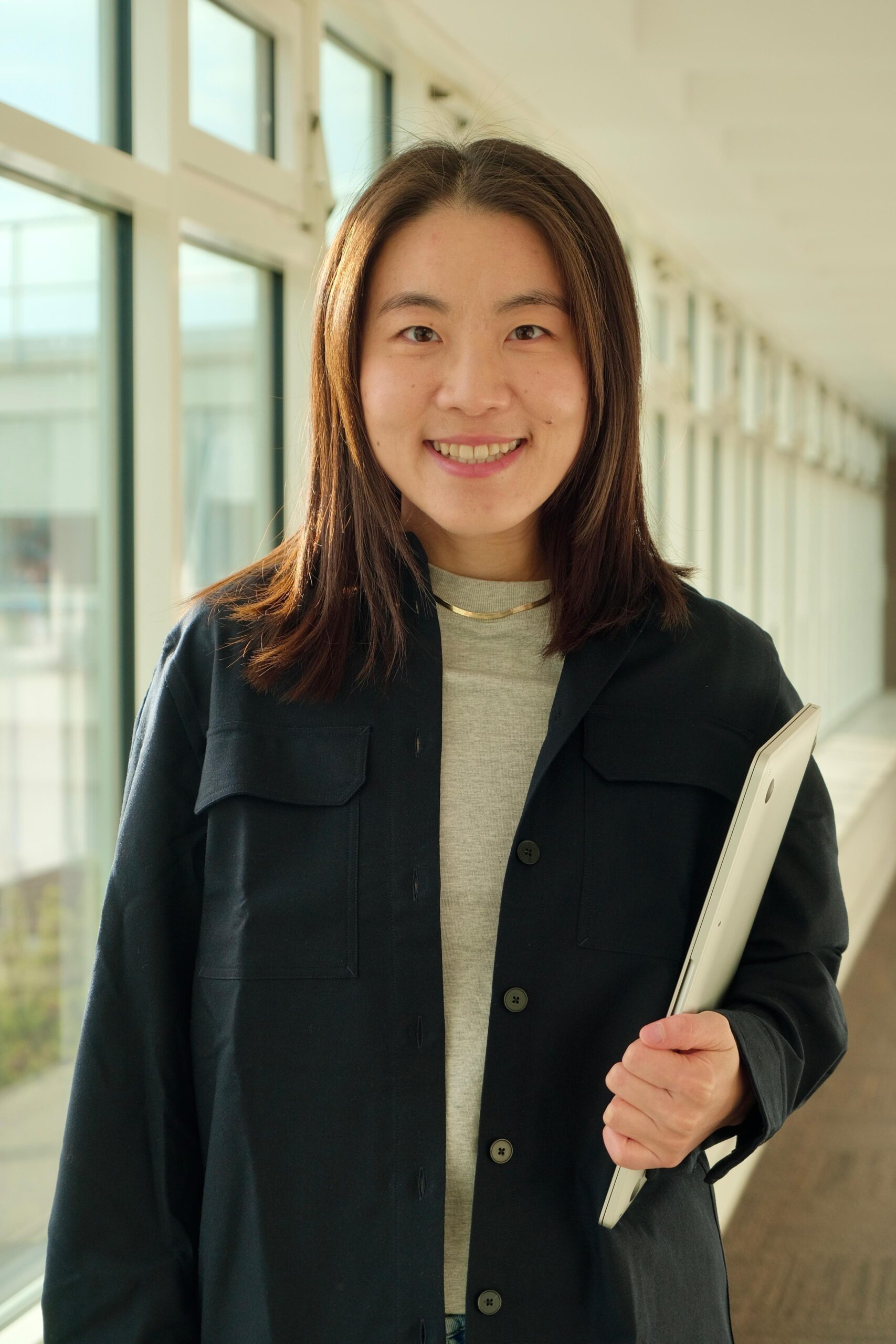
Name: Kehang Bai
Title: Pappalardo Fellow in Physics: 2026-2029
Email: kehangbai@gmail.com
Phone: TBA
Office: MIT Department of Physics
77 Massachusetts Avenue, 4-304
Cambridge, MA 02139
Related Links:
Pappalardo Fellowships in Physics
Area of Physics
Research Interests
Kehang Bai is an experimental particle physicist who seeks to discover new fundamental particles and forces at the Large Hadron Collider (LHC). The LHC collides protons with the highest energies ever achieved in terrestrial experiments, recreating particle interactions from the first picosecond of the universe’s existence. Data from these collisions may reveal answers to some of the deepest questions about the fundamental laws of nature and uncover rare phenomena beyond the Standard Model of particle physics.
With the ATLAS experiment, Kehang specializes in searching for unconventional signatures from hidden-sector physics using novel analysis techniques. She initiated and led the first ATLAS search for low-mass, long-lived dark photons with displaced vertices in the silicon tracker. She also developed weakly supervised learning methods to identify semi-visible jets from strongly interacting hidden sectors. Moving forward, she aims to study the Higgs boson as a portal to new physics by measuring its fundamental properties at the CMS experiment.
Kehang’s research also focuses on instrumentation, with expertise in front-end electronics and track reconstruction using silicon detectors. She contributed to the operation and ongoing upgrade of the ATLAS pixel detector. She is currently interested in advancing silicon tracking detector technology through continued work on High-Luminosity LHC upgrades and targeted R&D efforts to enable future discoveries.
Biographical Sketch
Kehang (可航), whose name in Chinese means “able to voyage”, grew up in Inner Mongolia, China, and has followed her curiosity across the world in the pursuit of fundamental science. She received a B.Sc. in Physics from the Hong Kong University of Science and Technology in 2020 and began her Ph.D. at the University of Oregon under the supervision of Prof. Laura Jeanty. During her Ph.D., she was an affiliate at the Lawrence Berkeley National Laboratory, contributing to the ATLAS Inner Tracker upgrade for the High-Luminosity LHC and designing state-of-the-art machine learning applications for particle physics. She subsequently continued her work at CERN in Geneva, Switzerland, leading a team of 20 researchers to search for unconventional dark sector signatures and serving as Run Manager for ATLAS Pixel detector operations.
Selected Publications
- Kehang Bai, Radha Mastandrea, and Benjamin Nachman. “Non-resonant anomaly detection with background extrapolation”. JHEP 04 (2024) 059. arXiv: 2311.12924.
- ATLAS Collaboration. “A search for R-parity-violating supersymmetry in final states containing many jets in pp collisions at √s = 13 TeV with the ATLAS detector”. JHEP 05 (2024) 003. arXiv: 2401.16333.
- Chiara Arina et al. “t-channel dark matter models – a whitepaper”. Eur.Phys.J.C 85 (2025) 975. arXiv: 2504.10597.