Did Scientists Just Detect an Exploding Black Hole?
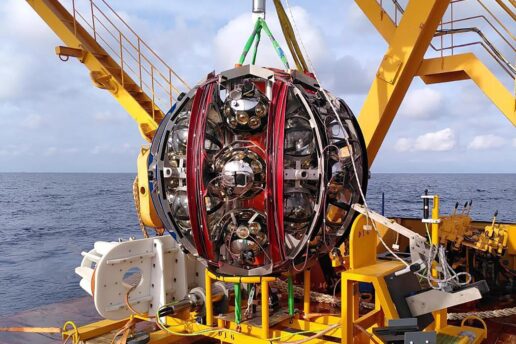
An underwater observatory recently detected a startlingly energetic cosmic neutrino. One possible cause involves a phenomenon that so far exists only in theory.
Prof. David Kaiser and graduate student Alexandra Klipfel speak with New York Times reporter Dennis Overbye about their theory that a neutrino detected zipping through the Mediterranean Sea in February 2023 may have come from an exploding primordial black hole. “Dr. Kaiser and Ms. Klipfel concluded that if primordial black holes were the explanation for long-sought dark matter, scientists should expect about 40 black-hole explosions to occur each year in every cubic light-year near the Milky Way,” Overbye notes. “You’ll never, ever hope to see Hawking radiation if the only black holes ever were ones that formed from dead stars,” says Kaiser. Primordial black holes have different masses and different lifetimes, he noted: “Some go bang right now.”
Related news and articles:
- Monster Neutrino Could Be a Messenger of Ancient Black Holes [Quanta Magazine, 01.23.2026]
- Could a primordial black hole’s last burst explain a mysteriously energetic neutrino?
[MIT News, 9.18.2025] - A. P. Klipfel and D. I. Kaiser, “Ultrahigh-Energy Neutrinos from Primordial Black Holes,” Phys. Rev. Lett. 135, 121003 (2025). DOI: 10.1103/vnm4-7wdc
- Alexandra P. Klipfel and David I. Kaiser, “Ultrahigh-energy neutrinos from primordial black holes,” Phys. Rev. Lett. 135: 121003 (2025), arXiv:2503.19227