Physicists zero in on the mass of the fundamental W boson particle
The team’s ultra-precise measurement confirms the Standard Model’s predictions.
When fundamental particles are heavier or lighter than expected, physicists’ understanding of the universe can tip into the unknown. A particle that is just beyond its predicted mass can unravel scientists’ assumptions about the forces that make up all of matter and space. But now, a new precision measurement has reset the balance and confirmed scientists’ theories, at least for one of the universe’s core building blocks.
In a paper appearing today in the journal Nature, an international team including MIT physicists reports a new, ultraprecise measurement of the mass of the W boson.
The W boson is one of two elementary particles that embody the weak force, which is one of the four fundamental forces of nature. The weak force enables certain particles to change identities, such as from protons to neutrons and vice versa. This morphing is what drives radioactive decay, as well as nuclear fusion, which powers the sun.
Now, scientists have determined the mass of the W boson by analyzing more than 1 billion proton-colliding events produced by the Large Hadron Collider (LHC) at CERN (the European Organization for Nuclear Research) in Switzerland. The LHC accelerates protons toward each other at close to the speed of light. When they collide, two protons can produce a W boson, among a shower of other particles.
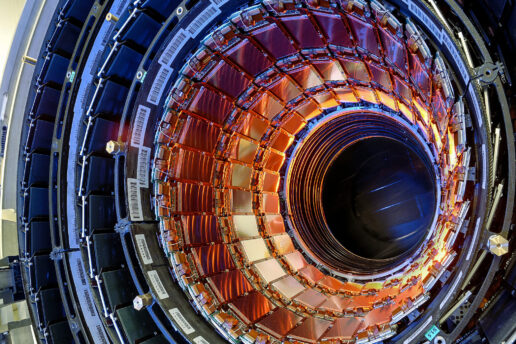
Catching a W boson is nearly impossible, as it decays almost immediately into two types of particles, one of which, a neutrino, is so elusive that it cannot be detected. Scientists are left to measure the other particle, known as a muon, and model how it might add up to the total mass of its parent, the W boson. In the new study, scientists used the Compact Muon Solenoid (CMS) experiment, a particle detector at the LHC that precisely tracks muons and other particles produced in the aftermath of proton collisions.
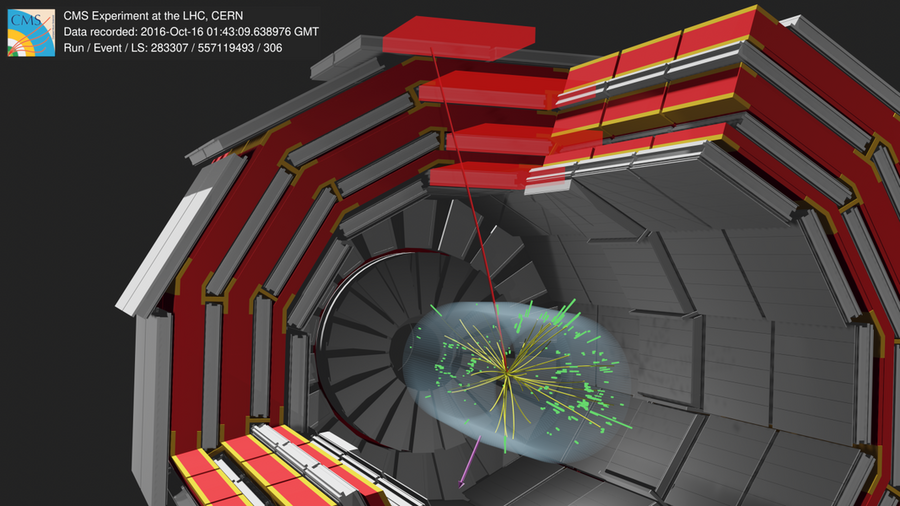
Image: CMS/CERN
From billions of proton-proton collisions, the team identified 100 million events that produced a W boson decaying to a muon and a neutrino. For each of these events, they carried out detailed analyses to narrow in on a precise mass measurement. In the end, they determined that the W boson has a mass of 80360.2 ± 9.9 megaelectron volts (MeV). This new mass is in line with predictions of the Standard Model, which is physicists’ best rulebook for describing the fundamental particles and forces of nature.
The precision of the new measurement is on par with a previous measurement made in 2022 by the Collider Detector at Fermilab (CDF). That measurement took physicists by surprise, as it was significantly heavier than what the Standard Model predicted, and therefore raised the possibility of “new physics,” such as particles and forces that have yet to be discovered.
Because the new CMS measurement is just as precise as the CDF result and agrees with the Standard Model along with a number of other experiments, it is more likely that physicists are on solid ground in terms of how they understand the W boson.
“It’s just a huge relief, to be honest,” says Kenneth Long, a lead author of the study, who is a senior postdoc in MIT’s Laboratory for Nuclear Science. “This new measurement is a strong confirmation that we can trust the Standard Model.”
The study is authored by more than 3,000 members of CERN’s CMS Collaboration. The core group who worked on the new measurement includes about 30 scientists from 10 institutions, led by a team at MIT that includes Long; Tianyu Justin Yang PhD ’24; David Walter and Jan Eysermans, who are both MIT postdocs in physics; Guillelmo Gomez-Ceballos, a principal research scientist in the Particle Physics Collaboration; Josh Bendavid, a former research scientist; and Christoph Paus, a professor of physics at MIT and principal investigator with the Particle Physics Collaboration.
Piecing together
The W boson was first discovered in 1983 and is predicted to be the fourth heaviest among all the fundamental particles. Multiple experiments have aimed to narrow in on the particle’s mass, with varying degrees of precision. For the most part, these experiments have produced measurements that agree with the Standard Model’s predictions. The 2022 measurement by Fermilab’s CDF experiment is the one significant outlier. It also happens to be the most precise experiment to date.
“If you take the CDF measurement at face value, you would say there must be physics beyond the Standard Model,” says co-author Christoph Paus. “And of course that was the big mystery.”
Paus and his colleagues sought to either support or refute the CDF’s findings by making an independent measurement, with an experiment that matches CDF’s precision. Their new W boson mass measurement is a product of 10 years’ worth of work, both to analyze actual particle collision events and to simulate all the scenarios that could produce those events.
For their new study, the physicists analyzed proton collision events that were produced at the LHC in 2016. When it is running, the particle collider generates proton collisions at a furious rate of about one every 25 nanoseconds. The team analyzed a portion of the LHC’s 2016 dataset that encompasses billions of proton-proton collisions. Among these, they identified about 100 million events that produced a very short-lived W boson.
“A particle like the W boson exists for a teeny tiny moment — something like 10-24 seconds — before decaying to two particles, one of which is a neutrino that can’t be measured directly,” Long explains. “That’s the tricky part: You have to measure the other particle — a muon — really well, and be able to piece things together with only one piece of the puzzle.”
Gathering momentum
When a muon is produced from the decay of a W boson, it carries half of the W boson’s mass, which is converted into momentum that carries the muon away from the original collision. Due to the strong magnetic field inside the CMS detector, the electrically charged muon follows a path whose curvature is a function of its momentum. Scientists’ challenge is to track the muon’s path and every interaction it may have with other particles and its surroundings, in order to estimate its initial momentum.
The muon’s momentum is also influenced by the momentum of the W boson before it decays. Decoding the impact of the W boson’s motion from the effects of its mass presented a major challenge. To infer the W boson mass, the team first carried out simulations of every scenario they could think of that a muon might experience after a proton-proton collision in the chaotic environment of the particle collider. In all, the team produced 4 billion such simulated events described by state-of-the-art theoretical calculations. The simulations encoded diverse hypotheses about how the muon momentum is affected by the physical features of the CMS detector, as well as uncertainties in the predictions that govern W boson production in LHC collisions.
The researchers compared their simulations with data from the 2016 LHC run. For every proton-proton collision event that occurs in the collider, scientists can use the CMS detector at CERN’s LHC to precisely measure the energy and momentum of resulting particles such as muons. The team analyzed CMS measurements of muons that were produced from over 100 million W boson events. They then overlaid this data onto their simulations of the muon momentum, which they then converted to a new mass for the W boson.
That mass — 80360.2 ± 9.9 megaelectron volts — is significantly lighter than the CDF experiment’s measurement. What’s more, the new estimate is within the range of what the Standard Model predicts for the W boson’s mass, bolstering physicists’ confidence in the Standard Model and its descriptions of the major particles and forces of nature.
“With the combination of our really precise result and other experiments that line up with the Standard Model’s predictions, I think that most people would place their bets on the Standard Model,” Long says. “Though I do think people should continue doing this measurement. We are not done.”
“We want to add more data, make our analysis techniques more precise, and basically squeeze the lemon a little harder. There is always some juice left,” Paus adds. “With a better look, then we can say for certain whether we truly understand this one fundamental building block.”
This work was supported, in part, by multiple funding agencies, including the U.S. Department of Energy, and the SubMIT computing facility, sponsored by the MIT Department of Physics.