On the hunt for “the source code of the universe”
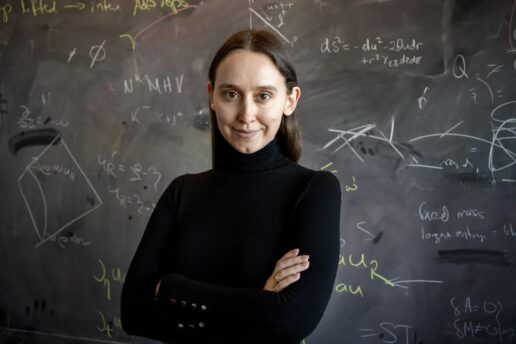
Sabrina Gonzalez Pasterski ’13
Physics is riddled with paradoxes: Think of how information leaks from supposedly inescapable black holes or how the conventional laws of physics break down at the quantum scale. Sabrina Gonzalez Pasterski ’13 believes that within these apparent contradictions, new discoveries await.
“What’s fun about physics is sometimes you think you know various things, and then you start [combining them] and you find a problem,” she says. “And so physics is about iteratively trying to correct our understanding of things so that they fit together in a consistent whole.”
This is Pasterski’s current mission as a high-energy theorist at the Perimeter Institute for Theoretical Physics in Ontario. She and her colleagues are working to unite general relativity, which describes gravity and the macroscopic world, with quantum mechanics, which describes the behavior of subatomic particles. It’s a field of physics research known as quantum gravity.
If Pasterski helps solve this problem that has vexed scientists for decades, the result will be the holy grail of physics: a fundamental theory of nature that characterizes pretty much everything. One day there may be engineering applications. “If you understand how things work,” she says, “you can do things with that knowledge.” But she’s in this to solve an existential puzzle—to reveal what she calls “the source code of the universe.”
She spends her days writing and deriving equations, because “mathematical frameworks can be rigid enough for us to test the consistency of theories that otherwise you can’t probe with experiment,” she says. Pasterski is reducing the universe’s many theoretical dimensions to just four—time and three dimensions of space. This work is called “celestial holography” because of its similarity to creating a hologram to represent a 3D image in two dimensions. She says it’s “a pretty good approximation of the real world.”
Big challenges are not new to Pasterski; she has always set her sights high. As a kid, she initially wanted to become a pop star. Then, after reading the Harry Potter series, she decided she’d like to be able to fly. “I wanted to get a flying broomstick,” she recalls. “My dad got my grandpa to get me a Cessna instead.” She didn’t just take flying lessons. She spent two years building a fixed-wing plane from a kit, modifying it to make it safer—and then she flew it herself. All by the age of 16.
Over time, her interest in aerospace engineering morphed into a fascination with theoretical physics. The field sounded challenging. “I like hard things,” she says. “I don’t think I knew what I was getting into.”
MIT was an ideal place for her scientific interests to take root as an undergraduate. “First of all, they always had you working hard,” Pasterski says. “I do better under pressure. They were hard courses—they could get you up to speed. And I really loved that. I love MIT.”
Pasterski estimates there are probably only a couple of thousand people in the world with whom she can meaningfully converse about her work in physics. (The late Stephen Hawking was once one of them; Pasterski met him when she was a grad student at Harvard and later found herself in a conga line with him during a Boston Harbor cruise.) But within that community, the work is deeply collaborative. “You’re building something much bigger than yourself,” she says.
When she gets into the right mindset and the equations of a simplified universe really get flowing through her mind, Pasterski can become immersed for hours on end. “You forget the time,” she says. “It’s nice to feel compelled to keep working.”
She feels fortunate to have found an area of intellectual exploration that she loves. Pasterski believes there’s some fundamental description of the universe out there, waiting to be discerned. “I’m happy to be a part of this legacy that our field is building,” she says.