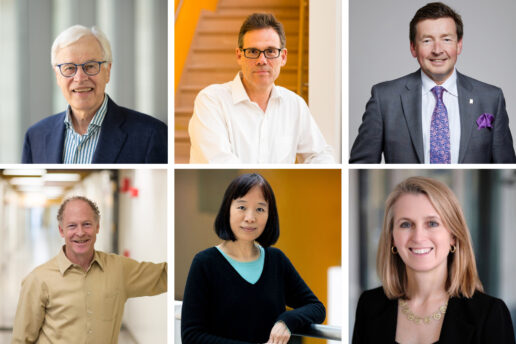
Photos: Fee: Justin Knight; Holmström: Bryce Vickmark; Wang: Caitlin Cunningham. McKinley, Nelson, and Wolfram courtesy of their respective schools.
MIT affiliates elected to National Academy of Sciences for 2026
Six MIT faculty, along with 10 additional alumni, are recognized by their peers for their outstanding contributions to research in the natural and social sciences.
The National Academy of Sciences (NAS) has elected 120 members and 25 international members for 2026, including six MIT faculty members and 10 additional alumni.
Among MIT professors, Bengt Holmström, Michale Fee, Gareth McKinley ’91, Keith Nelson, Fan Wang, and Catherine Wolfram ’96 were elected in recognition of their “distinguished and continuing achievements in original research.”
Additional alumni who were elected include Christopher J. Chang PhD ’02 (Chemistry); Cynthia J. Ebinger SM ’86, PhD ’88 (Earth, Atmospheric and Planetary Sciences); Andrew Gelman ’85, ’86 (Mathematics and Physics); Richard L. Greene ’60 (Physics); Chuan He PhD ’00 (Chemistry); Pardis C. Sabeti ’97 (Biology/Life Sciences); Robert J. Shiller SM ’68, PhD ’72 (Economics); Daniel M. Sigman PhD ’97 (EAPS); Eero Simoncelli SM ’88, PhD ’93 (Electrical Engineering and Computer Science); and Salil P. Vadhan PhD ’99 (Mathematics).
Membership in the National Academy of Sciences is one of the highest honors a scientist can receive in their career. The NAS is a private, nonprofit institution that was established under a congressional charter signed by President Abraham Lincoln in 1863. It recognizes achievement in science by election to membership, and — with the National Academy of Engineering and the National Academy of Medicine — provides science, engineering, and health policy advice to the federal government and other organizations.
Bengt Holmström is the Paul A. Samuelson Professor of Economics, emeritus. He received his doctoral degree from the Stanford Graduate School of Business in 1978 and held faculty positions at Northwestern University and Yale University before joining the MIT faculty in 1994 with a joint appointment in economics and management.
Holmström is best known for his foundational research on the theory of contracting and incentives, for which he received the 2016 Sveriges Riksbank Prize in Economic Sciences in Memory of Alfred Nobel (together with Oliver Hart of Harvard University). His extensive contributions to contract theory as applied to the theory of the firm, corporate governance, and liquidity problems in financial crises have had wide-ranging impacts, while bringing contract theory into mainstream economic thought.
In addition to the Nobel, Holmström’s research has been recognized with the Stephen A. Ross Prize in Financial Economics and the Grand Cross of the Order of the Lion of Finland. He is a member of the American Academy of Arts and Sciences, the Econometric Society, and the American Finance Association. Holmström is also an elected foreign member of the Royal Swedish Academy of Sciences and a member of the Finnish Academy of Sciences and Letters.
Michale S. Fee is the Glen V. and Phyllis F. Dorflinger Professor of Neuroscience, head of the MIT Department of Brain and Cognitive Sciences (BCS), and investigator at the McGovern Institute for Brain Research. His research explores how the brain learns and generates complex sequential behaviors. Using the zebra finch as a model system, Fee investigates the neural mechanisms underlying birdsong — a behavior that young birds learn from their fathers through trial and error, much as human infants learn to speak through babbling. His research extends far beyond birdsong — the neural circuits controlling birdsong learning are closely related to human brain circuits disrupted in Parkinson’s and Huntington’s diseases. Insights from Fee’s research could reveal new clues to the causes and potential treatments of these complex brain disorders.
After receiving his BE with honors in engineering physics at the University of Michigan in 1985, Fee studied applied physics at Stanford University, where he carried out his PhD thesis work in the laboratory of Steven Chu. In 1992, he began working as a postdoc in David Kleinfeld’s lab in the Biological Computation Research Department at Bell Laboratories. Four years later, he became a permanent member of the technical staff at Bell Labs and began working on the mechanisms of vocal sequence generation in the songbird. In 2003, he became an investigator at the McGovern Institute and a faculty member in BCS. In 2021, he was appointed BCS department head, continuing the department’s tradition of being led by scientists whose exemplary work makes MIT a world leader in brain science. Fee is a member of the American Academy of Arts and Sciences and a recipient of multiple undergraduate and graduate teaching awards at MIT.
Gareth H. McKinley ’91 is the School of Engineering Professor of Teaching Innovation in the Department of Mechanical Engineering at MIT, former associate head and interim head of the department, and co-founder of Cambridge Polymer Group. McKinley’s research interests include non-Newtonian fluid dynamics, microfluidics, extensional rheology, field-responsive materials, super-hydrophobicity, drag reduction, and the wetting of nanostructured surfaces. His work focuses on understanding the rheology of complex fluids such as surfactants, biomaterials, gels, and polymers, which are ubiquitous in foods and consumer products.
McKinley has made outstanding contributions to viscoelastic fluid mechanics, understanding flow instabilities and stretching flows. His research group has developed novel instrumentation and customized rheological analysis techniques that have driven the field of rheology for complex and soft fluids. His instrumentation and testing algorithms, along with freely-distributed code for analyzing large amplitude oscillatory shear flow, and broad-band “chirp” rheometry, are used worldwide in industry and academia .
McKinley is the author of over 390 technical publications. He has won the Publication Award of the Society of Rheology twice (2007 and 2022), as well as the 2021 Walters Award from J. Non-Newtonian Fluid Mechanics. He was awarded the Bingham Medal of The Society of Rheology in 2013, the Gold Medal from the British Society of Rheology in 2014, and the G.I. Taylor Medal from the Society for Engineering Science in 2022. In 2019, he was elected to the National Academy of Engineering and was also inducted as a fellow of the Royal Society of London. In 2023, he was awarded an honorary doctorate from the Katholieke University of Leuven, and in 2024 became a corresponding member of the Australian Academy of Sciences. In 2025, he was elected to the American Academy of Arts and Sciences and also became a foreign fellow of the Indian National Academy of Engineering.
Keith A. Nelson, the Haslam and Dewey Professor of Chemistry, earned his BS in chemistry from Stanford University. After completing his doctoral studies in physical chemistry, also at Stanford, he conducted postdoctoral research with John P. McTague at the University of California at Los Angeles. In 1982, Nelson joined the MIT Department of Chemistry as an assistant professor.
His distinguished career has been recognized with numerous honors, including the William F. Meggers Award, the Bomem-Michelson Award, and the Frank Isakson Prize for Optical Effects in Solids. Research in the Nelson Group focuses on the time-resolved optical study and control of collective transformations in condensed matter, using pulses of light in the THz, optical, and X-ray spectral ranges and laser-generated strain waves to drive the modes of motion through which these changes occur.
Fan Wang is a professor of Brain and Cognitive Sciences, investigator at the McGovern Institute, and co-director of the K. Lisa Yang and Hock E. Tan Center for Molecular Therapeutics at MIT. She investigates the neural circuits that govern the dynamic interactions between brain and body, exploring how the brain generates sensory perceptions and controls movement. Wang uses cutting-edge techniques including optogenetics, in vivo electrophysiology, and in vivo imaging to make discoveries with profound clinical implications.
By developing innovative tools to study how brain circuits work, Wang discovered distinct populations of neurons activated by anesthesia that can suppress pain without blocking sensation, and can calm anxiety by regulating automatic body functions like heart rate. She also identified the brain circuits controlling rhythmic movements essential for exploration and communication. Together, these findings reveal how emotion, physiology, movement, and consciousness are deeply interconnected.
Before coming to MIT, Wang obtained her PhD from Columbia University working with Richard Axel, and received her postdoctoral training at the University of California at San Francisco and Stanford University with Marc Tessier-Lavigne. She became a faculty member at Duke University in 2003, where she was later appointed Morris N. Broad Professor of Neurobiology. Wang became an investigator at the McGovern Institute and a faculty member in the Department of Brain and Cognitive Sciences at MIT in 2021. She is a member of the American Academy of Arts and Sciences and a recipient of multiple undergraduate teaching and graduate mentorship awards at MIT.
Catherine D. Wolfram ’96 is the William Barton Rogers Professor in Energy and professor of applied economics in the MIT Sloan School of Management. Before coming to MIT Sloan, Wolfram previously served as the Cora Jane Flood Professor of Business Administration at the Haas School of Business at the University of California at Berkeley. From March 2021 to October 2022, she served as the deputy assistant secretary for climate and energy economics at the U.S. Treasury, while on leave from UC Berkeley. Before leaving for government service, she was the program director of the National Bureau of Economic Research’s Environment and Energy Economics Program and a research affiliate at the Energy Institute at Haas. Before joining the faculty at UC Berkeley, she was an assistant professor of economics at Harvard University. She received a PhD in economics from MIT in 1996 and an BA from Harvard in 1989.
Wolfram has published extensively on the economics of energy markets. Her work has analyzed rural electrification programs in the developing world, energy efficiency programs in the United States, the effects of environmental regulation on energy markets, and the impact of privatization and market restructuring in the United States and United Kingdom. She is currently working on projects at the intersection of climate, energy, and trade, including work on carbon border adjustment mechanisms and oil market sanctions. Since March 2025, Wolfram has served on the COP30 President’s Council on Economics, Finance, and Climate, and has chaired a working group on climate coalitions.