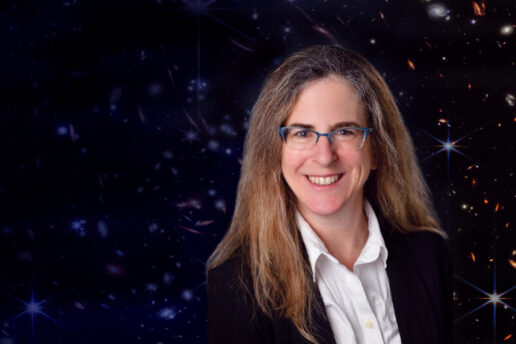
Growing up on a small farm in Nebraska, Megan Donahue ’85 discovered the wider world by reading her way through her local library. Today, she is learning how the wider world works by studying galaxy clusters.
A professor of physics and astronomy at Michigan State University, Donahue is trying to answer big questions, including How do galaxies form? and What is the role of supermassive black holes? “Every major galaxy has a supermassive black hole at its core,” says Donahue, who served as president of the American Astronomical Society from 2018 to 2020. “That central black hole seems to be the traffic cop of the whole system. How it does that is a huge mystery.”
Donahue discovered her passion for physics in the library at age 12. She went on to exhaust her high school’s math and science offerings—including physics, although that class wasn’t taught every year. Fortunately, thanks to a local pastor setting up a pipeline for advanced students, she got the chance to take additional classes such as calculus at a local college.
When the time came to go to university, Donahue was looking to leave Nebraska. A brochure that arrived in the mail from MIT caught her attention. “I thought: This looks so, so, so awesome,” she says. “I thought I’d fit in at MIT where they seemed to be selecting for geekiness. That turned out to be true—which was wonderful.”
A physics major at MIT, Donahue found her path into astronomy thanks to “a providential interaction.” Through the Undergraduate Research Opportunities Program (UROP), she got the chance to work at the Center for Space Research (today the MIT Kavli Institute), which was studying astronomical objects using cutting-edge X-ray imaging—work Donahue found “really cool.”
She went on to earn her PhD in astrophysics from the University of Colorado Boulder in 1990. “I needed the PhD to chart my own course scientifically,” she says.
Afterward, she completed one postdoc at the Carnegie Observatories in Pasadena, California, and a second at the Space Telescope Science Institute in Baltimore, Maryland. The latter—which she calls “a nexus of astronomy”—hired her as a staff astronomer in 1995, and she spent several years archiving data, including from the Hubble Space Telescope.
In 2003, she joined the faculty at Michigan State, where she now researches galaxy clusters and baryonic matter (matter made of protons and neutrons, as opposed to dark matter) in an effort to learn more about the composition of the universe and its evolution.
“Clusters of galaxies are very large scoops of the universe,” Donahue says. “It’s like taking a sample from the ocean. If you’re trying to find out the average composition of the ocean’s water, you’d want to study as big a scoop as possible.”
When she is not probing the mysteries of the universe, Donahue enjoys playing bass guitar in a couple of bands—an activity she started at MIT. “I saw people were having fun playing electric guitar, and there were not that many basses,” she says, recalling she played at a battle of the bands as a student. “I picked it up and I’ve been playing ever since.”
Looking back, Donahue truly appreciates these experiences. She was diagnosed with breast cancer in 2022, and while the cancer is in remission now, she has learned to value the time she’s been given even more. “Life hit me with a baseball bat, and I realized I have less control over my future than I thought I did,” she says. “I think that’s a good thing to learn.”
Photo illustration by Emily Kathan; photos by NASA and courtesy of Megan Donahue