Jeffrey Goldstone, pioneering theoretical physicist and MIT professor emeritus, dies at 93
A pioneer in quantum field theory, string theory, and quantum computing, the former CTP director leaves behind a profound research legacy spanning over six decades.
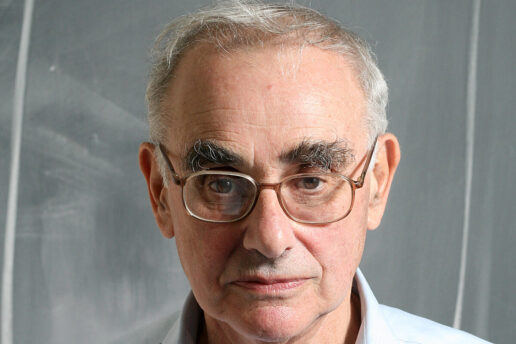
The Physics Department is very sorry to report that our colleague Jeffrey Goldstone, Cecil and Ida Green Professor Emeritus of Physics, died on October 12 at the age of 93.
Jeffrey began his career as a nuclear theorist. He earned his PhD from Trinity College, Cambridge in 1958 and did postdoctoral work at Cambridge, Harvard, CERN, and Copenhagen. After shifting his focus to particle theory, he joined the faculty at the University of Cambridge in 1962. He moved to MIT as a professor of physics in 1977 and was appointed the Cecil and Ida Green Professor of Physics in 1983. Jeffrey served as director of the Center for Theoretical Physics (now known as the MIT Center for Theoretical Physics — a Leinweber Institute) from 1983 to 1989. Even after retiring from MIT in 2004, he remained active in research for the next two decades, working in quantum computation.
Jeffrey’s research spanned a remarkable range of groundbreaking discoveries. In his early work on nuclear matter with Hans Bethe, he developed the use of Feynman diagrams for non-relativistic many-fermion systems. He later turned to particle physics, investigating relativistic field theories with spontaneously broken symmetries. Building on ideas inspired by superconductivity, he demonstrated that spontaneously broken continuous symmetries must be accompanied by massless, spinless particles — now widely known as Goldstone bosons (or Nambu-Goldstonebosons, in recognition of the Yoichiro Nambu’s earlier related insights). In subsequent work with Abdus Salam and Steven Weinberg, Jeffrey formalized and generalized this result, which became known as the Goldstone theorem. With Claudio Rebbi, Charles Thorn, and Peter Goddard, he worked out the light-cone quantization of relativistic strings, a foundational result in string theory. At MIT, Jeffrey worked with Roman Jackiw and Frank Wilczek on solitons in quantum field theory. Later, he turned to the emerging field of quantum computation, frequently collaborating with Edward Farhi, Sam Gutmann, and Andrew Childs.
Jeffrey was an APS Fellow; an Honorary Fellow of Trinity College, Cambridge; a Fellow of the Royal Society; and a Fellow of the American Academy of Arts and Sciences. His honors included the Guthrie Medal of the Institute of Physics, the Dannie Heineman Prize for Mathematical Physics of the APS, and the Dirac Medal of the Abdus Salam International Centre for Theoretical Physics (ICTP), awarded for “his fundamental clarification of the phenomenon of spontaneous symmetry violation in relativistic field theory.”
Jeffrey’s family is planning a memorial in 2027. A detailed obituary will appear soon in MIT News.