Nikta Fakhri
Research Interests
How do living systems coordinate the actions of thousands of individual components to build organisms, adapt to changing environments, and evolve new forms and functions? My research uncovers the physical principles that govern how living systems self-organize, process information, and generate collective behaviors far from thermodynamic equilibrium. Our lab combines quantitative experiments with statistical physics, geometry, topology, and machine learning to develop quantitative and predictive frameworks for living matter. We use diverse biological systems, including developing embryos, multicellular assemblies, and active biological materials, as experimental platforms for uncovering universal principles of collective dynamics. By revealing how irreversibility, nonreciprocal interactions, and information flow shape collective biological behavior, our work unifies molecular, cellular, and organismal dynamics within a common physical framework. Our long-term vision is to establish a quantitative physics of living systems that explains how complex biological function emerges from collective interactions across scales and informs the design of adaptive materials and engineered living systems.
Biographical Sketch
Nikta Fakhri is Professor of Physics at MIT and a member of the Physics of Living and Non-equilibrium Systems. She received her undergraduate degree from Sharif University of Technology, Tehran, Iran, earned her PhD from Rice University, and was a Human Frontier Science Program postdoctoral fellowship in Göttingen, Germany.
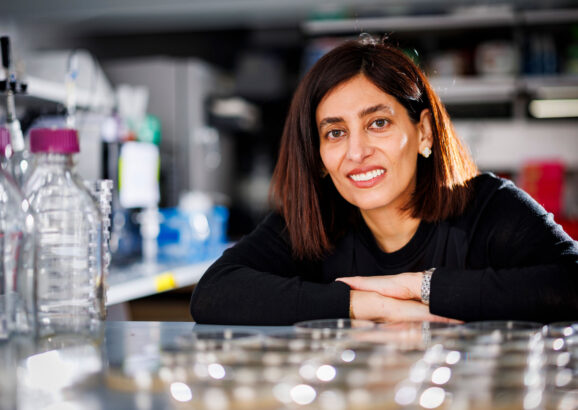
Photo credit by Steph Stevens
MIT scientists engineer starfish cells to shape-shift in response to light
The research may enable the design of synthetic, light-activated cells for wound healing or drug delivery.
Awards & Honors
- 2022 // Early Career Award for Soft Matter Research (APS) "For groundbreaking and inspiring developments in probing and analyzing biological systems as emergent non-equilibrium systems, elucidating how molecular-scale processes form cooperative functional structures at cellular and organismal scales."
- 2019 // NSF CAREER Award
- 2018 // IUPAP Young Scientist Prize in Biological Physics "For her significant contributions to applying fundamental principles of thermodynamics to experimental nonequilibrium biological systems, and advancing our understanding of how molecular-scale non-equilibrium processes are manifest in the system dynamics at larger scales.”
- 2017 // Appointed Thomas D. and Virginia W. Cabot Professor (MIT)
- 2017 // Sloan Research Fellowship
- 2016 // Human Frontier Science Program Organization (HFSPO) Career Development Award
Key Publications
-
YC Chao*, S Gokhale*, L Lin*, A Hastewell, A Bacanu, Y Chen, J Li, J Liu, H Lee, J Dunkel, N Fakhri. Selective excitation of work-generating cycles in nonreciprocal living solids (2026) Nature Physics 22, 474–482
-
J Liu*, T Burkart*, A Ziepke, J Reinhard, YC Chao, TH Tan, SZ Swartz, E Frey, N Fakhri. Light-induced cortical excitability reveals programmable shape dynamics in starfish oocytes (2025) Nature Physics 21, 846–855
-
TH Tan*, A Mietke*, J Li, Y Chen, H Higinbotham, PJ Foster, S Gokhale, J Dunkel, N Fakhri. Development drives dynamics of living chiral crystals (2022) Nature 607 (7918), 287-293
-
TH Tan*, J Liu*, PW Miller*, M Tekant, J Dunkel, N Fakhri. Topological turbulence in the membrane of a living cell (2020) Nature Physics 16, 657-662
-
J Li, JM Horowitz, TR Gingrich, N Fakhri. Quantifying dissipation using fluctuating currents (2019) Nature Communications 10 (1), 1666