Allan MacDonald and Pablo Jarillo-Herrero Win Frontiers of Knowledge Award for “Magic Angle” Discovery
The duo is recognized for the discovery of “twistronics,” a breakthrough in material science that allows scientists to control electronic behavior—including superconductivity—by simply rotating layers of graphene.
PRESS RELEASE
FUNDACIÓN BBVA
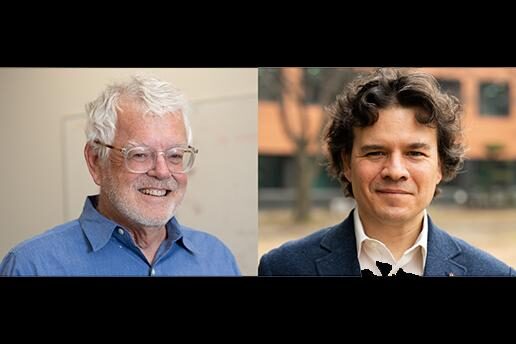
The BBVA Foundation Frontiers of Knowledge Award in Basic Sciences has gone in this eighteenth edition to physicists Allan MacDonald (The University of Texas at Austin) and Pablo Jarillo-Herrero (Massachusetts Institute of Technology, MIT) for their discoveries concerning the “magic angle” that allows the behavior of new materials to be transformed and controlled. What the committee terms the “pioneering” insights of the two researchers have provided both the theoretical foundation and experimental validation of a whole new field, now known as twistronics, where superconductivity, magnetism and other target properties can be obtained by rotating new materials such as graphene.
In his theoretical model published in 2011, Canadian Allan MacDonald predicted that by twisting two graphene layers at a given angle, in the region of one degree, the interaction of electrons would produce new emerging properties. Seven years later, Spaniard Jarillo-Herrero and his team provided the experimental confirmation, fabricating bilayers of graphene rotated at this “magic angle” that transformed the material’s behavior, giving rise to new properties like
superconductivity.
“Their work has opened up new frontiers in physics by demonstrating that rotating matter to a given angle allows us to control its behavior, obtaining properties that could have a major
industrial impact,” explained committee member María José García Borge, a Research Professor at the Institute for the Structure of Matter (IEM-CSIC). “Superconductivity, for example, could bring about far more sustainable electricity transmission, with virtually no energy loss.”
“The two men’s joint contributions have defined a vast new field for developing materials with highly sought-after, emerging properties, and set the agenda for research groups across the world,” added Luis Viña, Professor of Condensed Matter Physics at the Universidad Autónoma de Madrid and President of the Spanish Royal Physics Society, one of the nominators of the awardees. “MacDonald, from the standpoint of theory, and Jarillo-Herrero, through experiment, have become the architects of a new cutting-edge technology for creating hitherto unknown states of matter with the power to unlock advances in superconductivity and the creation of new electronic devices, and guide the future path of quantum computing.”
The properties of graphene, predicting the unexpected
Allan MacDonald’s scientific fascination with two-dimensional materials and their extraordinary physical properties first gripped him during a stay at the Max Planck Institute for Solid State Research, where he worked with Klaus von Klitzing (Nobel Prize in Physics in 1985). At the time, the illustrious German physicist’s lab was trying to create materials that could further their study of phenomena like superconductivity. “The vision they had was to make these artificial materials they could manipulate at will,” said the laureate in an interview shortly after hearing of the award. “But with the methods of the time they couldn’t make them perfect enough, with the structure needed to see the really interesting things.”
MacDonald was inspired by this vision to study unusual behaviors in stacked graphene sheets and, later, in other materials also formed by super-thin layers, seeking an entrance into a new world of properties with potential technological applications.
His research may be purely theoretical, but he is permanently on the lookout for results that can be translated to real-life situations, convinced of the need to find synergies between theory and experiment in the study of materials: “In twistronics, there is a hand and glove relationship between theory and experiment, like between the chicken and the egg. Theory is hugely important for experimentalists, because it points them toward which things are worth exploring. And experiments are a critical guide to theorists striving to understand the observed properties.”
In 2011, MacDonald predicted an unusual property of graphene, a material composed of a single layer of carbon atoms. By his calculations, on rotating one graphene sheet on top of another to a very precise angle, the electrons (which in conventional materials move at thousands of kilometers per second) would lose velocity, coming practically to a standstill. This dramatic slowdown raised the possibility of huge changes in the graphene’s behavior of a nature MacDonald could barely imagine when his results first appeared in the Proceedings of the National Academy of Sciences. The researcher gave the name of “magic angle” to this 1.1º misfit between the graphene layers.
An experimental validation from the realms of “science fiction”
The discovery, however, had little immediate impact, and it was not until some years later, when it was confirmed in the laboratory, that its true importance was revealed.
“The community would never have been so interested in my subject, if there hadn’t been an experimental program that realized that original vision,” observes MacDonald, who refers to his co-laureate’s achievement as “almost science fiction.”
Jarillo-Herrero, in effect, had been intrigued by the possible effects of placing two graphene sheets on top of each other with a precise rotational alignment, because “it was uncharted territory, beyond the reach of the physics of the past, so was bound to produce some interesting results.” But the scientist was still unsure of how to make it work in the lab. For years, he had been stacking together layers of this super-thin material, but without being able to specify the angle between them. Finally, he devised a way to control the misfit, making it smaller and smaller until he got to the “magic” angle of 1.1º at which the graphene revealed some extraordinary behavior.
“It was a big surprise, because the technique we used, though conceptually straightforward, was hard to pull off in the lab. We took a sheet, made of something like transparent kitchen wrap but a hundred thousand times thinner than a hair. We cut it into two pieces and, taking care to avoid wrinkles, placed one on top of the other so they were perfectly aligned.”
Writing up his results in two Nature papers of 2018, Jarillo-Herrero described how magic-angle graphene can become either insulating or superconducting, and that it is possible to tune its behavior with unprecedented precision. His contribution became the most cited of the year in all areas of knowledge, not just in Nature but in all the journals within its publishing group. With the technique his team developed, layers of two-dimensional materials can now be stacked at any chosen angle, giving rise to all kinds of novel properties.
The potential for using graphene to reproduce any property of matter
For the awardees, the impact of this discovery has only just begun. “By rotating superimposed layers of two-dimensional materials at different angles, we can realize every possible behavior of matter,” says Jarillo-Herrero. “Not just insulators and superconductors but also magnetism and a whole host of other complex behaviors.” Until lately, he points out, we needed different elements from the periodic table to observe such a wide range of properties, but now, with graphene, we can see them all in just one – carbon. This element, he reflects, has become a sort of “reverse philosopher’s stone”, where instead of turning any material into gold, we can make graphene take on the behavior of any other material.
But to bring all this knowledge to industrial applications, an essential first step is to find better ways to manufacture graphene layers with a specific twist angle. The current process is so artisanal that it takes weeks or even months to produce just one device. Those who carry out this task are “like medieval monks creating a manuscript,” says Jarillo-Herrero. “We don’t have a print shop where we can turn out thousands or millions of identical copies of the same device, and getting to that point will require a lot of research work in basic engineering. Though certainly the interest is there within the community.”
Future advances in our understanding of how graphene can be tuned to produce different behaviors of matter will lead to new materials with never-before-seen properties. “Among the likelier applications – says MacDonald – are new types of devices to convert information between computers and fiber optic cables. The technology is promising, and these materials are the best candidates for controlling optical properties electrically.” An eventual “print shop” of graphene sheets rotated to different angles will allow us to verify the predicted usefulness of these materials for quantum technologies like computing and sensors, and certain types of artificial intelligence, at a much lower energy cost.