From Farm to Fusion: A Scientific and Entrepreneurial Odyssey
How MIT alumnus Francesco Sciortino PhD ’21 is leading Proxima Fusion to turn stellarator-based nuclear energy from a long-held dream into commercial reality.
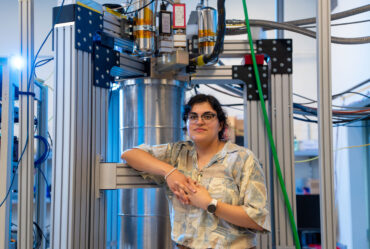
The physicist Francesco Sciortino PhD ’21 grew up on a hazelnut farm near Viterbo, Italy, a small city north of Rome, but he’s since ventured far from the family business. As cofounder and CEO of the fast-growing Proxima Fusion—based in Munich—Sciortino is trying to harness the process that makes the sun shine in the hopes of providing a practical and inexhaustible energy source for humanity.
That’s a lofty goal, but Sciortino likes a challenge. He was drawn to physics, in part, because he initially struggled with the subject as a student and vowed to do better. He attended secondary school in England, where he heard a talk by Melanie Windridge, a plasma physicist who was touring the country, telling students about the promise of fusion. Sciortino was impressed, describing her presentation as “the first time I heard someone talk about building a star in a lab.”
Transfixed by that notion, he decided to study plasma physics as an undergraduate at Imperial College London. Sciortino then earned a master’s degree at the Swiss Federal Technology Institute at Lausanne (EPFL), which had a donut-shaped experimental fusion device called a tokamak. In 2016, he continued his graduate studies at MIT, which also had an experimental tokamak. Sciortino came to MIT, he says, “because I thought it had the highest density of exceptional people in fusion worldwide.” Part of his PhD research was also carried out on the DIII-D tokamak at General Atomics in San Diego.
After receiving his PhD in Course 8 in 2021, he went to the Max Planck Institute for Plasma Physics in Germany, where he continued to work on tokamaks. But a year later—after a long personal involvement with tokamaks—he made a considered technical judgment: There was another option for a practical fusion machine that, he felt, could offer many advantages. Sciortino shifted his attention to a different, though related, kind of reactor called a stellarator, which resembles more of a “twisty donut.” Stellarators are more stable, in his opinion, and can operate continuously rather than in short bursts—in principle, running for months or even years.
“This technology will change a lot of lives.”
Francesco Sciortino PhD ’21
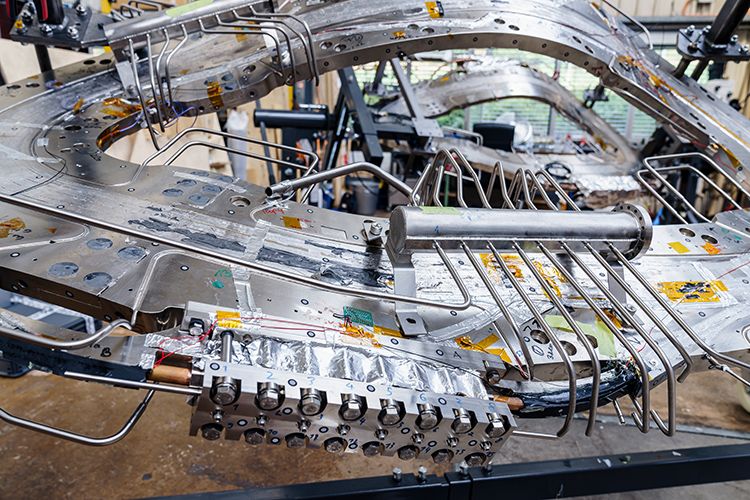
Photo courtesy of Proxima Fusion
The potential for “steady-state” operation was, for Sciortino, the make-or-break difference. In early 2023, he decided the time was right to commercialize stellarator technology, and he teamed up with four others—including Lucio Milanese PhD ’23—to found Proxima Fusion. Sciortino and Milanese had been classmates at Imperial College, EPFL, and MIT. Both had been trained on tokamak physics, and both ultimately concluded that stellarators were the way to go. Owing to advances in magnet technology, computation, and optimization, they believed—as did their cofounders—that stellarator science had matured to the point where the remaining engineering problems were solvable.
Proxima has set ambitious goals of producing a demonstration reactor (Alpha) by the early 2030s and, later in the decade, an actual fusion power plant called Stellaris—which would be, by far, the largest stellarator ever built. The company has already raised about $740 million from private investors, including Google, and from public grants. The government of Bavaria has committed another $450 million, with Proxima lining up additional financial support from the German federal government as well.
While funding is critical to this effort, Proxima is still working to address significant technical issues. More powerful magnets are needed to allow for smaller, simpler, and cheaper power plants. Sciortino is also focusing on maintenance, which he calls “one of the least understood challenges of fusion.” Proxima’s reactors will be built in sectors that can, he says, “be pulled apart like pizza slices” to enable equipment and parts to be repaired and replaced.
The remaining technical hurdles—both known and yet to be uncovered—haven’t dimmed Sciortino’s excitement about the promise of generating fusion energy from fuels, hydrogen isotopes, that are readily available. “When fusion rolls out commercially, you’re not burning anything, and the fuel is essentially free,” he says. “National wealth will no longer be bound by resources like oil and gas. This technology will change a lot of lives.” And Sciortino will be gratified to see that nuclear fusion—a subject that first attracted his interest in high school and later lured him to MIT—may soon be transformed from a long-held dream to a commercial reality.