MIT students study plasma physics beneath Alaska’s aurora
Student-led expeditions use distributed instruments to observe auroral structures and probe space plasma in real-world conditions.
For many graduate students, waking up at noon after a 4 a.m. bedtime is a sign of a night well spent. For a group of MIT students, it was simply the start of their workday — timed not to the sun, but to the aurora.
Their goal was simple: to study plasma phenomena using the aurora borealis as a natural laboratory. The process, less so; working largely in darkness in Fairbanks, Alaska, the students conducted experiments in temperatures that dipped as low as -25 degrees Fahrenheit, using red headlamps for visibility. The sun set before 3 p.m., and even at its warmest, temperatures barely reached 20 F.
The aurora provides a rare opportunity to observe plasma behavior directly, as charged particles that interact with Earth’s magnetic field produce visible, large-scale structures in the night sky. As Fairbanks is situated beneath a region of especially frequent auroral activity, it is one of the most reliable places in the world to observe these phenomena, though the conditions come with real constraints.
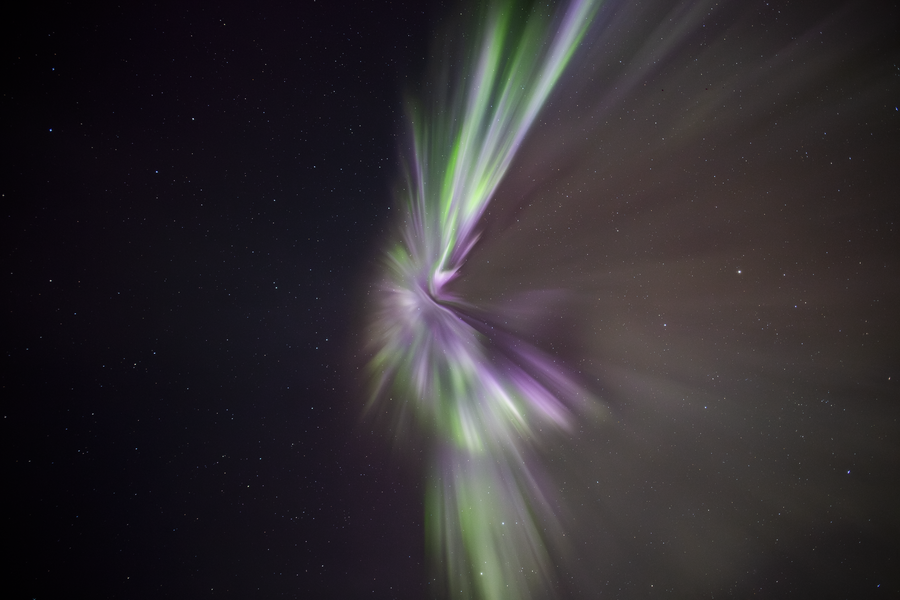
Photo: Noah Wolfe, with Leonardo Corsaro and Sydney Menne
For one thing, the extreme cold directly impacted the instrumentation. “Our laptops went from full battery to nearly empty in 10 minutes because of the cold,” says Leonardo Corsaro, a PhD student in physics at the Plasma Science and Fusion Center (PSFC) at MIT. “We were trying to transfer data as fast as possible before everything shut down; it was a race against time!”
The challenges extended beyond the cold itself. “The cold can be managed,” says Leon Nichols, a PhD student in physics at PSFC. “With good planning, you can stay comfy in -20 F. The real difficulty was movement when deploying cameras far away from the roads. Walking through thick snow can burn up to 900 calories in an hour. We used cross-country skis to access some of the more remote terrain that would have taken hours to reach otherwise.”
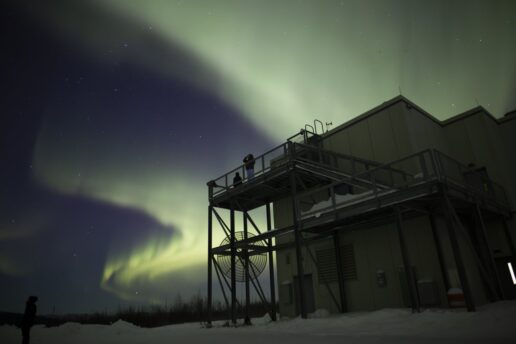
But the conditions were more than worth it: During their time in Alaska, the group witnessed the strongest solar storm in the past two decades, bringing the aurora to life in ways few will ever experience. “It felt like we were the only ones there,” Sydney Menne, a PhD student in nuclear science and engineering, recounts, “removed from the Earth and just entirely surrounded by the aurora, fully immersed in it.”
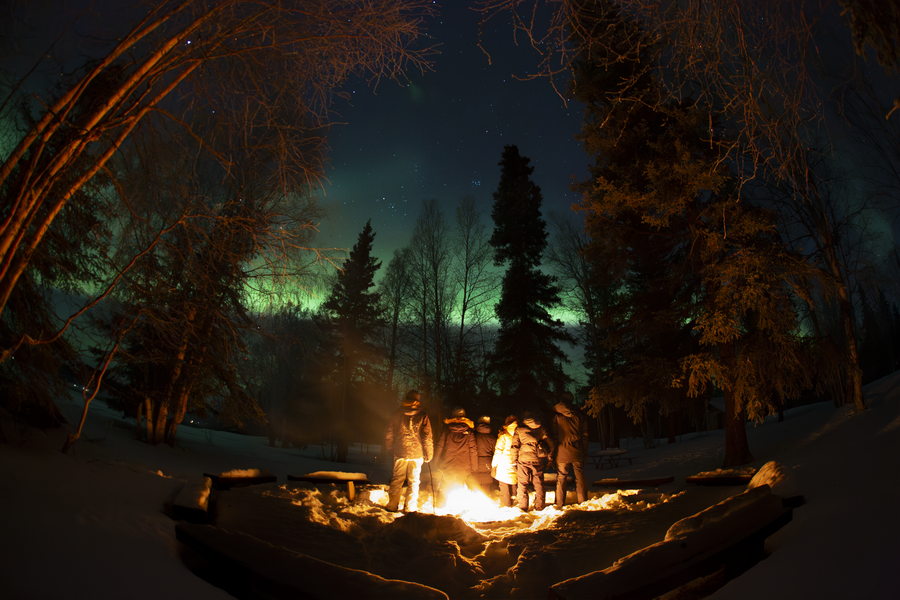
Photo: Noah Wolfe, with Leonardo Corsaro and Sydney Menne
The team was granted access to observation facilities at Poker Flat Research Range through the University of Alaska Fairbanks Geophysical Institute. Over the course of the trip, students deployed multiple all-sky camera systems across distances of up to 100 miles, enabling simultaneous observations of auroral structures from different locations. These cameras, which capture 360-degree images of the night sky, were paired with magnetometers to correlate visual auroral features with changes in Earth’s magnetic field.
By combining spatially distributed imaging with magnetic field measurements, the team aimed to capture how auroral structures change across space, with the long-term goal of supporting three-dimensional reconstructions of the aurora. This year’s campaign also expanded the measurements beyond imaging, using muon detectors to explore possible correlations between visual auroral activity, magnetic field changes, and particle detections, offering a potential window into how high-energy particles in the upper atmosphere relate to visible auroral activity.
Video: MIT-Nord Anglia Education Collaboration
Despite decades of study, many aspects of the aurora remain poorly understood, and each observation offers an opportunity to better characterize the behavior of plasma in near-Earth space. The team also observed a pulsating aurora, a relatively rare phenomenon in which strips of light stretching across the sky blink on and off multiple times per second. By combining instruments not traditionally applied to these problems and deploying low-cost systems at scale, the team is exploring new approaches to studying these phenomena. Insights from these observations can help improve our understanding of space weather, including how solar activity affects satellites, communications systems, and power infrastructure on Earth.
For some participants, the experience reshaped how they think about plasma physics itself. Corsaro explains, “In my research, it is easy to associate these phenomena with colorful plots and simulations, losing touch with the physical process. Seeing structures in the aurora, electric currents and flows forming and shifting overhead, brought a sense of reality to those concepts, and served as a reminder that real plasmas are far less neat and intuitive than theory suggests.”
The experience is part of a broader effort. This group of students represented the third iteration of the Geophysical Plasma Observation Expedition (GPOE), a project involving MIT students from the Plasma Science and Fusion Center, along with collaborating departments, that sends a cohort to Fairbanks, Alaska, each year. Faculty members now provide support for the expedition, while continuity is maintained through its student-driven structure, with each cohort including a mix of returning and new participants. The expedition is organized and led entirely by students and operates on an intensive, compressed timeline. Students are responsible not only for data collection, but also for instrument design, site selection, logistics, and post-processing, completing a full research cycle within a matter of months.
This year’s cohort included graduate students Leonardo Corsaro and Leon Nichols of PSFC; Sydney Menne of the Department of Nuclear Science and Engineering; and Noah Wolfe, Oleksandra “Sasha” Lukina, Leonardo Corsaro and Leon Nichols of the Laser Interferometer Gravitational-Wave Observatory (LIGO) Laboratory and the MIT Kavli Institute for Astrophysics and Space Research. The group was accompanied by Professor Matthew Evans, professor of physics at MIT, who is affiliated with the LIGO Laboratory and the Kavli Institute.
“This is an opportunity to go from concept to data analysis in just a few months,” says John Ball, a PhD student in nuclear science and engineering at PSFC. “That kind of compressed scientific cycle is rare, especially in our field.”
The program itself has relatively recent and somewhat unusual origins. It began in 2023, when graduate student Shon Mackie, frustrated by the lack of hands-on plasma diagnostic opportunities, noticed the solar cycle was approaching its peak and saw an opportunity to study plasma phenomena more directly. He drafted a short proposal to PSFC leadership, and the response from then-Director Dennis Whyte was two lines: “Sounds cool, literally! PSFC will fund this.”
Since its launch in 2023, GPOE has evolved from a single-camera effort into a multi-instrument, multi-site campaign with growing participation, with each cohort building on the work of previous years by refining instrumentation, expanding observational coverage, and improving data collection strategies.
This hands-on, student-driven approach has also created opportunities to extend the experience beyond MIT. In 2024, the program expanded to include a new outreach collaboration with the MIT Museum and the MIT Nord Anglia Collaboration, bringing approximately 65 high school students from around 20 schools worldwide to MIT to help design and build components of the all-sky camera systems used in the field. Working within a set of technical constraints, students developed and tested designs, ultimately producing 13 cameras that were deployed during the Alaska expedition.
Video: MIT-Nord Anglia Education Collaboration
The program has also begun to produce results beyond the expedition itself. Students have presented their work at major conferences, including the American Geophysical Union, and published findings in peer-reviewed journals such as Earth and Space Science. The group’s low-cost all-sky camera and magnetometer design is now being adopted by other research teams and community science initiatives, extending its impact beyond MIT.
Beyond its scientific goals, participants emphasized the broader impact of the experience.
“Standing outside at midnight in Alaska, staring up at sheets of glowing plasma stretching thousands of kilometers across the sky, really brings home just how small and delicate our own place in the universe is,” says Ball.
As the program continues to grow, students hope to expand both its technical capabilities and its reach, including more permanent instrumentation and expanding outreach partnerships. For many involved, the expedition represents not just a research opportunity, but a reminder of the scale and immediacy of the phenomena they study.
“Science is an adventure,” Corsaro says. “This kind of work reminds you why you became a scientist in the first place.”