After MIT, the Marines: A Polymath Reports for Duty
Always up for a challenge, Braedon Rudolph ’26 double majored in physics and economics before commissioning as an officer in the Marines
Four months after graduating from MIT with a dual major in physics and economics, Braedon Rudolph ’26 will report to Quantico, Virginia, to begin four more intense years, this time as an officer in the Marines.
“They have the hardest training,” he says, noting that he was drawn to the Corps’ reputation for personal challenge and pride.
Rudolph has always been driven to do the hard thing. As a boy, he ran to and from Denver’s Lowry Elementary School every day to see if he could beat the bus. At home, he read popular physics books, such as those by Brian Greene and Michio Kaku, and practiced classical pieces on the piano for competitions.
By middle school, he was a student in a pre-International Baccalaureate (IB) program, an avid athlete—playing lacrosse, football, basketball, soccer, tennis, golf, and baseball—and a tuba player in the school band, where he also conducted pieces for a live audience and composed his first full-orchestra work, a play on “Chim Chim Cher-ee” from Mary Poppins.
At George Washington High School, Rudolph completed the IB diploma, a program rigorous enough to require finishing all AP coursework by sophomore year. He also concentrated his athleticism on lacrosse and broadened his musical pursuits, playing drums with a couple of different bands and traveling to festivals. His interest in jazz and classical music deepened, and he remembers tailgating concerts with his grandfather at Colorado’s iconic Red Rocks Park and Amphitheatre.
During these years, he became known, he says, as “the one annoying reactionary guy” for his questioning of the dominant political narrative at his school. He was on the school’s speech and debate team, which was ranked fourth in the nation, and specialized in a style known as Lincoln-Douglas, where questions are viewed through various moral and ethical frameworks.
Coping with tragedy early in life
When Rudolph was 17, his mother died of breast cancer, a disease she’d had since he was 5 years old. The following week, after his family spread her ashes in Telluride, Colorado, the beloved grandfather he had tailgated classical concerts with got sick and died within days.
In coping with these two losses in quick succession, Rudolph later realized that the long, slow nature of his mother’s illness had taught him to anticipate and process emotions before they happened. “Somehow you mourn her before she’s gone, because her personality is dying, humor’s gone, she’s just very frail.” This “pre-emoting,” as he calls it, helped him absorb his mother’s death but it also blunted his joy, including when he learned of his acceptance to MIT. “I wish I was more happy during that,” he says.
Everything to the max
His path to MIT began with a throwaway comment. He was in the middle of the college lacrosse recruitment process when, at his grandparents’ house one day, “I jokingly suggested, ‘What about MIT?’” His father didn’t see why not. “I was like, ‘Really? There’s no way I’m getting in.’” But his father encouraged him to explore the idea, and Rudolph reached out to MIT’s lacrosse coach.
The coach had seen Rudolph play at a few camps and responded positively, he says. “At that point, I had to decide between applying to MIT and a bunch of other places early.” After visiting the Institute, he says, “I chose MIT because of the balance, ironically. Everything is to the max but that means there’s a balance. It just means it’s heavier weights on both sides”—lacrosse on one side, academics on the other, he says.
There was also a third force in play at the time: the military. He initially had an ROTC scholarship to attend MIT but was able to drop it, and the time commitment it would require, when he got the Miranda Family Scholarship. This funding meant that he could take more classes and explore his interest in applying physics to economic modeling.
In academic year 2024–2025, 57% of undergraduates were awarded an MIT scholarship.
Rudolph played lacrosse at the Institute for two years before stepping away to focus on academics and research, including a project with Enrico Scalas at Sapienza University in Rome on random matrix theory in finance. He also took a PhD-level macroeconomics course with Institute Professor Daron Acemoglu, who won the Nobel Prize in Economics that same semester.
During his junior-year Independent Activities Period, Rudolph created an economic impact model for nuclear energy projects around the world—a model he’s since used in a consulting capacity for The Nuclear Company, Clean Core Thorium Energy, and two European governments, and that’s continuing to attract the interest of other potential clients, he says.
Throughout these years, he also found time to compose: a wind quintet, piano solos, a cello solo, a flute solo, and a string quartet. He graduated with 307 credits, far above the 180 to 198 required minimum.
The Miranda Family Scholarship, which allowed him to take these extra credits, was also meaningful in another way. After Rudolph’s mother died, his father bore the financial pressure of funding Rudolph’s education, and that of his sister. “It was just extremely helpful for me to feel better about being such a burden on my dad, and just all the stress on my dad,” he says.
Reporting for duty
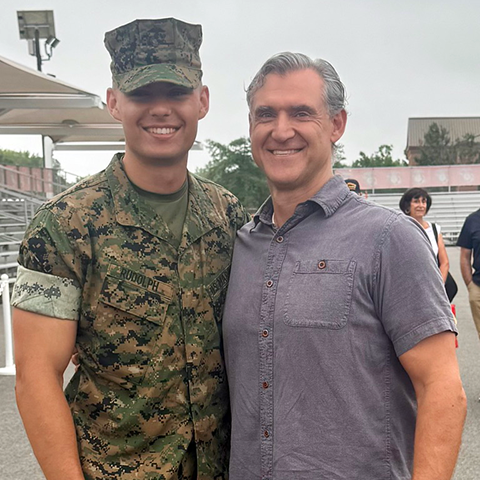
Although he opted out of the ROTC scholarship, Rudolph found another path to prepare for the military, attending a 12-week Officer Candidate School over two summers. In November 2025, he won the USMC Boston Strong Award, which goes to a Greater Boston–area officer candidate who scores the highest in physical fitness, leadership ability, academic tests, and tactical thinking. Rudolph had the best grade in each category.
Rudolph anticipates he’ll want another challenge after completing his service in the Marines. He recalls a friend asking him, “You do MIT, you do the Marines, and then where are you going to find the rush that it seems like you kind of need in life?” His answer: a startup. As for what kind, “I have no clue,” he says. “But I do know I want to start a high school, actually,” one with a great reading list and “good both-sides discussion about any issue.”
But first, 2nd Lt. Rudolph’s next stop is Quantico, where he hopes to take up a role in ground intelligence.
SUPPORT SCHOLARSHIPS AT MIT
At MIT, impact begins with people—and recent graduates like Braedon Rudolph are an integral part of that story. MIT graduates go on to make a difference in every field, applying the Institute’s hands-on approach to solving problems that matter. By supporting scholarships, you help ensure that every student who accepts an offer of admission has the resources and support to thrive at MIT and contribute their talents wherever they can have the greatest impact. Make your scholarship gift.